
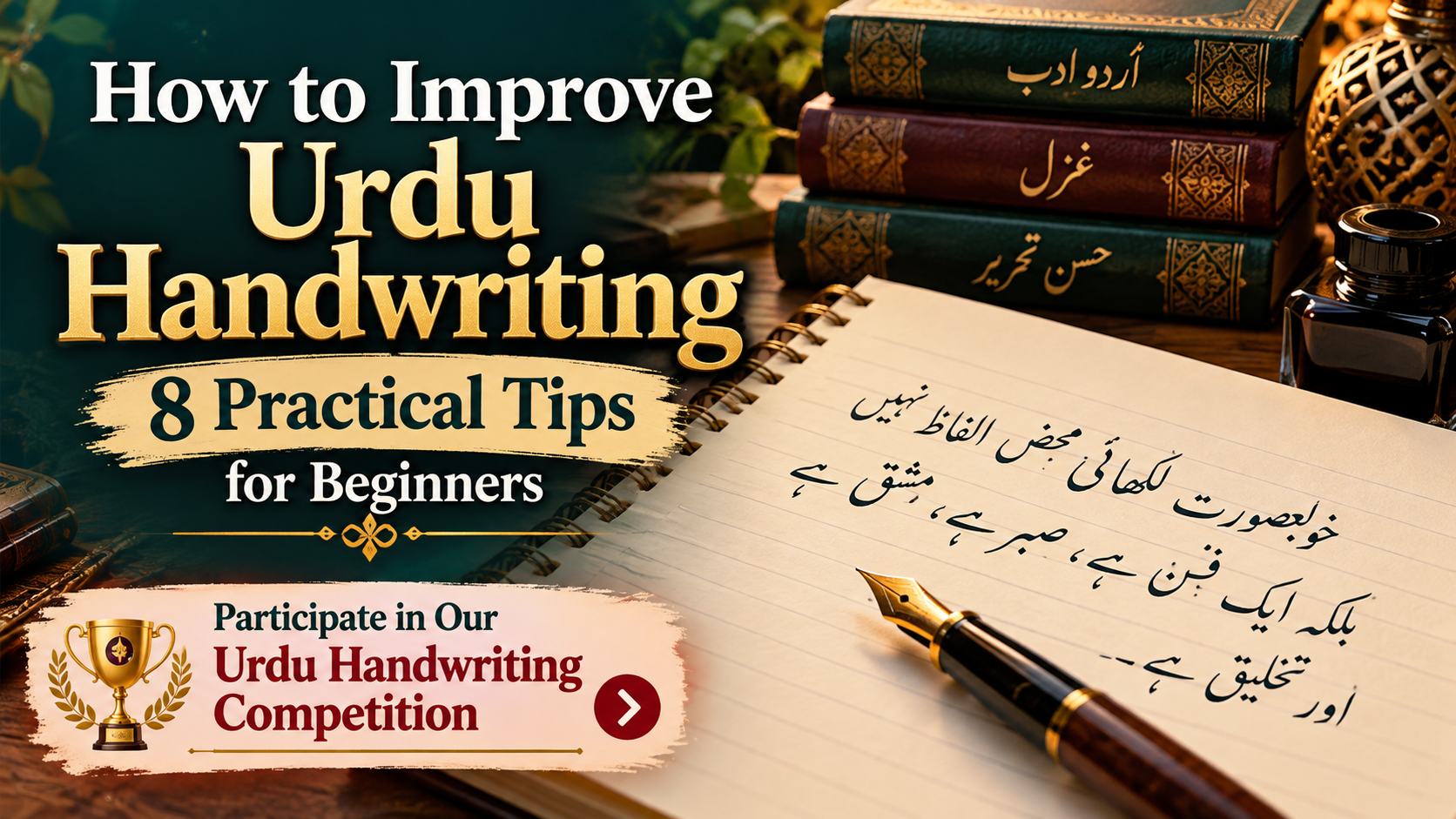

Beautiful handwriting is an art that combines patience, practice, concentration and creativity. Urdu is especially admired for its flowing letters, elegant curves and distinctive calligraphic style. Whether you are a student, a handwriting enthusiast or someone preparing for an online handwriting competition, improving your Urdu handwriting can be a rewarding experience.
In this guide, you will learn practical ways to improve your Urdu handwriting, make your writing more attractive and prepare for a handwriting competition.
Why Is Urdu Handwriting Special?
Urdu is written from right to left and uses a beautiful script in which letters connect to form words. The shape, spacing and balance of letters play an important role in making Urdu writing easy to read and visually appealing.
Good Urdu handwriting is not only about decoration. It is also about clarity, consistency, proper letter formation and balanced spacing between words and lines.
- Practise Every Day
Regular practice is one of the best ways to improve handwriting. Start by practising for 10 to 15 minutes daily. Choose a short Urdu passage, a poem or a few meaningful sentences and write them carefully.
Focus on accuracy before trying to increase your writing speed. As your control improves, your handwriting will gradually become more consistent.
- Focus on the Shape of Urdu Letters
Pay attention to the correct formation of individual Urdu letters. Practise letters that you find difficult, and observe how their shapes change depending on their position in a word.
Try to maintain consistent letter sizes and avoid unnecessary variations in the shape of the same letter.
- Maintain Proper Spacing
Spacing can make a significant difference in the appearance of your writing.
Leave enough space between words.
Keep the distance between lines consistent.
Avoid crowding letters or stretching words unnecessarily.
Maintain a balanced appearance across the page.
Well-spaced writing is easier to read and often looks more professional.
- Choose the Right Pen and Paper
Use a pen that feels comfortable in your hand and produces a smooth, consistent line. Practise on paper with enough space to write comfortably.
You do not necessarily need an expensive pen. The most important things are control, comfort and consistent writing.
- Keep Your Writing Straight and Balanced
Try to keep your words and lines aligned. If you are using plain paper, practise maintaining a consistent baseline. If you are using lined paper, use the lines as a guide.
Also pay attention to the balance of letters above and below the writing line.
- Learn from Good Urdu Handwriting Examples
Look at well-written Urdu passages and observe the letter shapes, spacing, word proportions and overall arrangement.
You can learn from printed Urdu text, traditional Nastaliq examples and handwriting samples. Use these examples for practice while developing your own consistent writing style.
- Practise with Urdu Poetry
Urdu poetry provides excellent material for handwriting practice. Couplets often have a natural rhythm and are enjoyable to write.
Choose a short ghazal or a few couplets and concentrate on clear letters, balanced spacing and neat presentation. You can gradually progress to longer passages as your confidence improves.
- Prepare for a Handwriting Competition
If you want to participate in a handwriting competition, practise writing neatly within the given instructions. Read the rules carefully and make sure your submission follows the required format.
Before submitting your work:
Check that your writing is clear and legible.
Make sure the photograph or scanned image is sharp.
Ensure the entire page is visible.
Avoid shadows, glare and tilted images.
Follow all submission and judging instructions.
Remember that attractive handwriting should also be easy to read. Neatness and consistency are more valuable than unnecessary decoration.
Participate in an Urdu Handwriting Competition
Do you enjoy writing Urdu beautifully? Put your skills to the test by exploring our Urdu Handwriting Competition, organised by Urdu Poetry Contest to celebrate حسنِ تحریر and the beauty of the Urdu script.
Visit the competition page to read the rules, explore available entries and learn how participation and judging work.
Explore the Urdu Handwriting Competition
Frequently Asked Questions
How can I improve my Urdu handwriting quickly?
Practise for 10 to 15 minutes every day. Concentrate on correct letter formation, spacing, consistency and legibility rather than speed alone.
What makes Urdu handwriting beautiful?
Clear letter shapes, balanced proportions, consistent spacing, smooth writing and a neat overall presentation all contribute to beautiful Urdu handwriting.
Can beginners participate in a handwriting competition?
Eligibility depends on the specific competition’s rules. Read the official instructions before preparing your submission.
Is Urdu handwriting the same as Urdu calligraphy?
No. Handwriting is everyday writing produced by hand, while calligraphy generally focuses more on the artistic design and formal execution of letters. Both celebrate the beauty of the Urdu script.
Final Thoughts
Improving Urdu handwriting takes time, but regular practice and attention to detail can make a noticeable difference. Start with simple exercises, learn from good examples and gradually develop a style that is both attractive and readable.
Celebrate the beauty of Urdu writing, continue practising and discover the joy of حسنِ تحریر.
